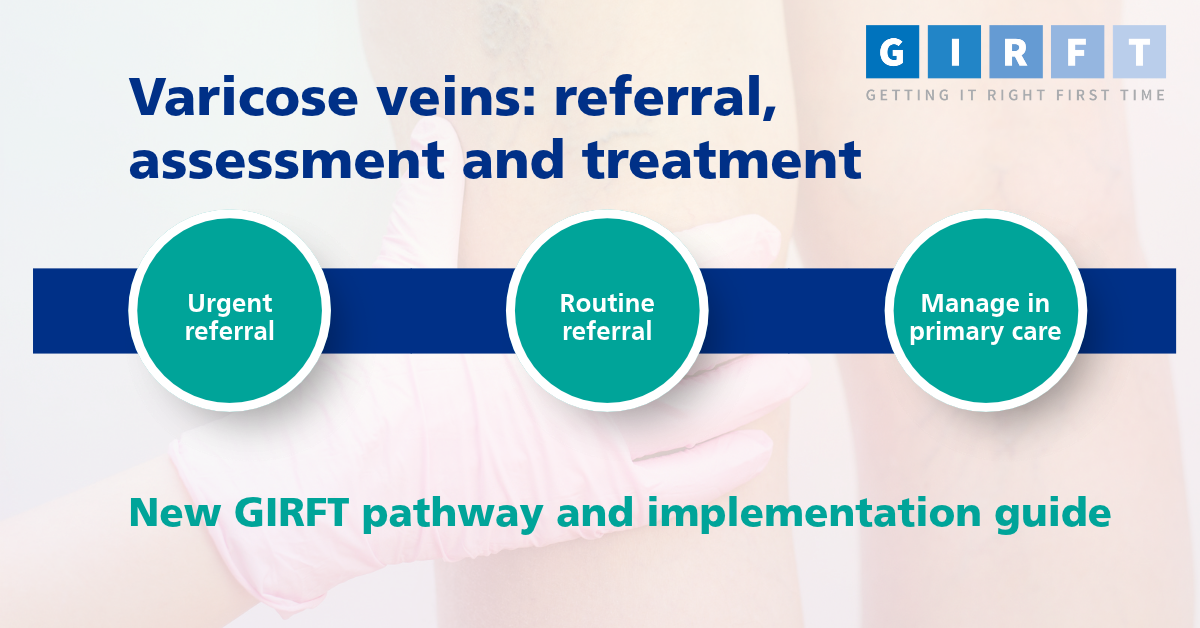
NHS colleagues working in primary care, vascular services and commissioning can now access GIRFT’s new pathway for patients presenting with varicose veins, along with guidance to support with implementation.
Varicose veins are a common condition affecting around 20-30% of adults, and can affect quality of life, daily activity and work, as well as leading to more serious complications.
National guidance recommends referral for specialist assessment where varicose veins are symptomatic or complicated, while treatment for cosmetic reasons is not supported.
However, data shows that access to assessment and treatment for varicose veins varies significantly across England and there is wide variation in local threshold policies. In practice this means some vascular services accept most referrals – in some cases affecting their capacity for urgent life and limb-threatening work – and others require bleeding or active ulceration before referral or treatment is considered.
GIRFT’s new standardised pathway for varicose veins, co-badged by the Vascular Society and the Venous Forum of the Royal Society of Medicine, outlines best practice across the patient pathway from presentation to discharge and follow-up, including the requirements of referral information and the key elements of an effective preoperative one stop clinic.
The pathway is supported by guidance offering implementation advice, including detailed referral criteria (for example, when to refer urgently and when to refer routinely), guidance for managing varicose veins in primary care where appropriate, and links to further information.
It sets out a pragmatic middle ground for threshold policies, advising against referral for cosmetic or asymptomatic varicose veins, but ensuring that patients with clinically significant symptoms and the greatest potential to benefit from treatment are referred and prioritised.
Rachel Bell and Jon Boyle, GIRFT’s joint clinical leads for vascular surgery, said:
“Clear, standardised criteria for varicose veins can reduce uncertainty for our colleagues in primary care, support consistent triage by vascular services, and reduce avoidable prior approval requests, retrospective challenge and unnecessary imaging.
We hope this standardised pathway will be adopted widely, helping to improve equity, reduce delays and make demand more manageable, so that patients with the greatest clinical need can be assessed and treated in a more timely way.”Rachel Bell and Jon Boyle Tweet